
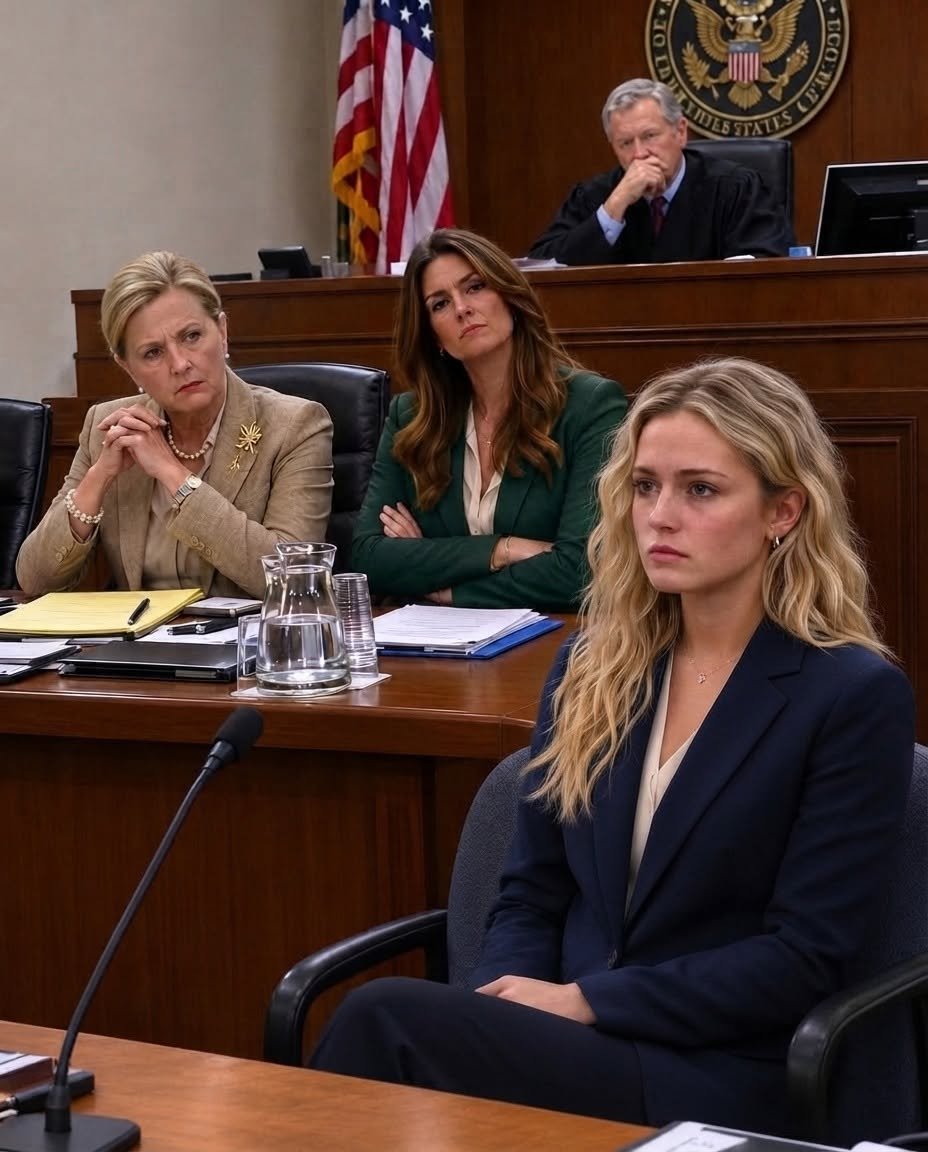
Comme si je l’avais trompée en réussissant sans permission.
Le juge Morland attendit.
Mon père s’éclaircit la gorge.
« Votre Honneur, il y a clairement eu un malentendu. »
Le juge se tourna vers lui.
« Un malentendu ? »
« Oui. »
Sa voix s’adoucit en ce ton maîtrisé.
« On nous a donné des raisons de croire que notre fille exagérait ses réalisations professionnelles. »
« Par qui ? »
Il hésita.
Brenda répondit.
« Par moi. »
Tous les visages se tournèrent vers elle.
Elle se redressa.
« Je connais ma sœur depuis toujours. »
Le juge Morland resta impassible.
« Je suppose que oui. »
« Et elle a toujours eu tendance à embellir. »
J’ai failli rire.
Au lieu de cela, j’ai regardé.
Brenda continua.
« Elle disait aux gens qu’elle était avocate, mais chaque fois que nous posions des questions basiques, elle devenait évasive. »
« Quand as-tu demandé ? »
Brenda cligna des yeux.
« Quoi ? »
« Quand as-tu demandé à ta sœur son travail ? »
Silence.
Le juge Morland se pencha en arrière.
« Vous avez déposé une plainte sous serment alléguant que Mme Hamilton s’était faussement présentée comme avocate agréée. Vous avez sûrement mené une enquête d’abord. »
Ma mère se raidit.
« On a essayé. »
« Comment ? »
« Elle ne voulait pas nous fournir de documents. »
Le juge Morland m’a regardé.
« Ils t’ont demandé ta carte de bar ? »
« Non, Votre Honneur. »
« Ton numéro de bar ? »
« Non. »
« Tes informations de cabinet d’avocats ? »
« Non. »
« Ont-ils fouillé le registre des avocats du Massachusetts ? »
Brenda ouvrit la bouche.
Personne ne répondit.
La juge Morland retira lentement ses lunettes.
« Le registre des procureurs publics ? »
Mon père se tortilla, mal à l’aise.
« Nous ne connaissons pas les bases de données juridiques. »
« Tu n’as pas besoin de l’être. Cela apparaît dans une recherche internet ordinaire. »
Brenda rougit.
Ma mère s’est tournée vers moi.
« Tu aurais pu nous montrer. »
Voilà.
Je l’ai finalement regardée droit dans les yeux.
« Tu aurais pu me croire. »
Sa bouche se referma.
Le juge Morland nous regarda tour à tour.
« Mlle Hamilton, savez-vous ce qui a motivé cette plainte ? »
« Je sais ce qu’ils m’ont dit. »
« Et c’était quoi ça ? »
« Que Brenda découvre que je disais aux gens que j’étais avocat et commence à craindre que je commets une fraude. »
Le juge regarda Brenda.
« C’est exact ? »
« Oui. »
Elle répondit trop vite.
Le juge Morland l’a remarqué.
Moi aussi.
Le conseiller juridique du comité, un homme au visage fermé nommé M. Avery, a ouvert un autre dossier.
« Juge, puis-je ? »
« S’il te plaît. »
Il ajusta son micro.
« La licence de Mme Hamilton a été vérifiée de manière indépendante. Elle est membre active du barreau du Massachusetts depuis neuf ans, sans antécédents disciplinaires. »
Ma mère le fixait.
« Neuf ? »
Quelque chose d’ancien a changé en moi.
Neuf ans.
Elle ne le savait même pas.
M. Avery poursuivit.
« Son historique professionnel rapporté est exact. Son dossier de procès est exact. Son rôle dans Fitzgerald est exact. »
Brenda baissa les yeux.
« Et, » a-t-il ajouté, « le comité a reçu trois lettres de juges en exercice et de deux anciens procureurs fédéraux répondant à l’avis de la plainte. »
L’expression de mon père changea.
« Des lettres ? »
« Ils traitent de la réputation professionnelle de Mme Hamilton. »
La juge Morland remit ses lunettes.
« C’est pourquoi nous faisons maintenant face à un autre problème. »
Elle regarda Brenda.
« Si cette plainte a été déposée de bonne foi. »
La tête de Brenda se releva brusquement.
« Bien sûr que oui. »
« Alors aide-moi à comprendre quelque chose. »
Judge Morland raised the original complaint.
“You state here that your sister has never attended law school.”
Brenda swallowed.
« Oui. »
“She graduated from Suffolk University Law School.”
“I didn’t know that.”
I stared at her.
So did the judge.
“You didn’t know where your sister spent three years?”
“We weren’t close.”
My mother cut in.
“She told us she was studying something related to legal administration.”
I looked at her.
“No, I didn’t.”
Her face hardened.
“Yes, you did.”
« Non. »
“You absolutely did.”
My pulse slowed.
In court, witnesses occasionally give you something they don’t realize they’ve given.
A contradiction.
A sentence too certain.
A detail that opens a door.
My entire career had trained me to recognize those doors.
This one hurt because my mother stood behind it.
“When?” I asked.
She blinked.
“When what?”
“When did I tell you I was studying legal administration?”
“Years ago.”
“Where?”
“I don’t remember.”
“On the phone?”
“Probably.”
“Before or after my graduation?”
Her eyes flickered.
Judge Morland watched closely.
My mother snapped, “Why does that matter?”
“Because you didn’t come to my graduation.”
Silence.
Brenda glanced at our father.
My mother shifted.
I continued.
“You told me you couldn’t attend because Brenda’s wedding was the same weekend.”
Brenda tightened her expression.
“And?”
“And I mailed you my graduation announcement.”
My father lowered his eyes.
“It said Suffolk University Law School.”
Nobody moved.
My mother whispered, “I don’t remember that.”
“I do.”
Brenda folded her arms.
“So we’re bad parents. That doesn’t prove malicious intent.”
Mr. Avery looked at her.
“No. But something else may.”
He removed a sheet of paper.
Brenda’s face changed instantly.
Barely.
But enough.
I saw it.
Judge Morland did too.
M. Avery poursuivit.
“Ms. Brenda Hamilton, did you contact the law firm of Mercer, Vale & Bishop six weeks ago?”
My breath caught.
My firm.
Brenda stared at him.
She said nothing.
“Ms. Hamilton?”
“I may have.”
“Why?”
“I wanted to verify my sister worked there.”
“Did you?”
Her mouth tightened.
« Oui. »
Mr. Avery glanced at the page.
“According to an affidavit from the firm’s managing partner, you were informed that your sister was a senior trial attorney.”
My mother turned toward Brenda.
« Quoi ? »
Brenda went pale.
The room shifted again.
M. Avery poursuivit.
“You were also directed to Ms. Hamilton’s public professional biography, which listed her education, bar admission, representative cases, awards, and speaking engagements.”
My father slowly turned.
“Brenda?”
She kept staring ahead.
Judge Morland’s voice cooled.
“So before you filed a sworn complaint claiming there was ‘no way’ your sister had passed the bar, you had already confirmed with her employer that she was a practicing attorney.”
Brenda’s composure cracked.
“I thought they were covering for her.”
Silence followed so completely I could hear her breathing.
Judge Morland leaned forward.
“You believed an established law firm had fabricated a senior attorney’s identity?”
Brenda’s cheeks reddened.
“I didn’t know what to believe.”
“That is not what your complaint says.”
Mr. Avery slid another paper forward.
“You also emailed Suffolk University.”
Brenda looked at him.
My mother whispered, “You did what?”
“And received confirmation that privacy rules prevented disclosure beyond publicly available commencement records. You then accessed the archived commencement program.”
He paused.
“Your sister’s name appears in it.”
Brenda stayed silent.
My father shifted his chair several inches away from her.
That tiny movement hurt more than I expected.
Not because I wanted him to defend me.
Because I understood exactly what it meant.
He wasn’t horrified by what she had done.
He was distancing himself from it.
Judge Morland turned toward my parents.
“When did your daughter tell you she believed Ms. Hamilton was impersonating an attorney?”
My mother swallowed.
“About two months ago.”
“And did she tell you she had contacted the firm?”
“No.”
“Did she tell you she had found the commencement record?”
“No.”
My father stared at Brenda.
“You said the firm wouldn’t verify her.”
Brenda looked at him.
“I said they gave me evasive answers.”
“No,” Mr. Avery said. “They did not.”
He opened one final document.
“The call was recorded pursuant to the firm’s standard intake policy.”
Brenda froze.
My stomach tightened.
I hadn’t known that either.
Mr. Avery pressed a button.
A woman’s voice filled the room.
“Mercer, Vale & Bishop.”
Then Brenda’s.
Bright.
Polite.
Controlled.
“I’m trying to confirm whether my sister actually works there. Her name is Claire Hamilton.”
My name.
For the first time in years, hearing Brenda say it made me feel sixteen again.
The receptionist replied.
“Yes. Ms. Hamilton is one of our senior trial attorneys.”
A pause.
Brenda’s recorded voice shifted.
“Senior?”
“Yes, ma’am.”
“And she’s licensed?”
Another pause.
“Yes.”
Then Brenda laughed.
That same laugh.
Light.
Dismissive.
The laugh from the Connecticut dinner.
“That’s hard to believe.”
No one moved.
The recording continued.
Brenda asked for my bar number.
The receptionist directed her to the public registry.
She asked whether I had actually handled trials.
The receptionist directed her to my professional biography.
Then came the sentence that destroyed her explanation.
“So if I filed a complaint saying she wasn’t really licensed, what would happen?”
The receptionist sounded confused.
“Ma’am?”
“I mean hypothetically.”
Mr. Avery stopped the recording.
Brenda looked drained.
Judge Morland stared at her.
“You asked that before filing.”
Brenda’s eyes filled.
“I was angry.”
Almost a whisper.
My mother recoiled.
“What?”
Brenda pressed her hands against the table.
“I was angry.”
“At what?” I asked.
She finally looked at me.
And suddenly I saw fifteen years of comparison from the opposite direction.
“You weren’t supposed to be this.”
I frowned.
“This what?”
“Successful.”
My mother whispered her name.
“Brenda.”
But my sister had already started.
“You were supposed to have the normal life.”
Her voice trembled.
“The practical life. I was the one who went to Yale. I was the one everyone expected things from.”
I stared at her.
“And?”
“And then my marriage fell apart.”
Her eyes flooded.
“My career stalled. Mom and Dad still talk about Yale because it’s the last impressive thing I did.”
My father flinched.
Brenda laughed bitterly.
“And then somebody at a charity dinner mentioned Fitzgerald.”
I stopped breathing.
“She said Claire Hamilton was brilliant.”
Brenda looked directly at me.
“I thought it had to be another Claire Hamilton.”
“So you checked.”
“Yes.”
“And found me.”
“Yes.”
“And then filed a fraud complaint.”
Her face crumpled.
“I wanted something about it not to be true.”
The honesty was hideous.
And somehow sad.
Judge Morland allowed the silence to remain.
Then my mother reached toward Brenda.
My sister pulled away.
“Don’t.”
My mother froze.
Brenda looked at her.
“You did this.”
My mother stared back.
“You spent my whole life telling me I was special because she wasn’t.”
My chest tightened.
“Brenda—”
“No.”
She faced me.
“Every time you did something good, they explained why it didn’t count.”
My father stiffened.
“That is not true.”
Brenda laughed.
“You called community college proof she lacked ambition.”
“You agreed.”
“I was sixteen!”
“You were older than she was.”
“And you were our father.”
That landed.
My father leaned back.
Brenda turned to our mother.
“When she got the scholarship, you said Suffolk wasn’t Yale.”
My mother whispered, “We were trying to keep expectations realistic.”
“For her.”
Brenda’s voice cracked.
“You never kept mine realistic. You made me responsible for being extraordinary.”
My mother stared at her.
“And when I stopped being extraordinary, I had no idea who I was.”
Nobody spoke.
For the first time, I saw our family machinery from both sides.
I had been starved of approval.
Brenda had been force-fed it until she believed losing it meant losing herself.
Neither was love.
Judge Morland removed her glasses.
“This committee will dismiss the complaint against Ms. Claire Hamilton with prejudice.”
I closed my eyes.
One breath.
That was all I allowed.
“The record will reflect that the allegations regarding her licensure and professional identity were demonstrably false.”
Then Judge Morland faced Brenda.
“The committee will refer the sworn statements and supporting materials for review regarding possible knowingly false submissions.”
Brenda’s lips trembled.
My mother gasped.
“Judge, please.”
“Mrs. Hamilton.”
“She made a mistake.”
Judge Morland’s expression sharpened.
“A mistake is an incorrect date.”
She tapped the file.
“This was a sustained effort to weaponize a professional disciplinary process against an attorney after evidence contradicted the accusation.”
My father half-rose.
“Surely this doesn’t need to destroy our daughter’s life.”
The sentence struck so hard I almost laughed.
Our daughter.
I looked at him.
Judge Morland did too.
Then she said slowly, “You have two daughters, Mr. Hamilton.”
He sat back down.
Nobody looked at me.
That was fine.
I had spent enough years waiting for them to.
The hearing ended.
Chairs scraped against the floor.
Papers moved.
People began filing out.
I remained seated.
Only then did my hands begin trembling under the table.
Not during the accusations.
Not during the recording.
Now.
Judge Morland stepped down from the bench and stopped beside me.
“Claire.”
I stood.
“Judge.”
“You did not need my praise today.”
“No.”
“But you have it.”
My throat tightened.
She lowered her voice.
“Do not let people who refused to witness your becoming convince you that your becoming was deception.”
I looked away briefly.
When I turned back, she wore a faint smile.
“Thank you.”
Then she left.
My parents remained near the doors.
Brenda stood several feet away from them.
I picked up my bag.
My mother approached.
“Claire.”
I stopped.
She looked smaller somehow.
Not physically.
Her certainty was gone.
“We didn’t know.”
I met her eyes.
“You didn’t want to.”
Her lips parted.
“That’s unfair.”
“No.”
My voice stayed level.
“Unfair was giving Brenda a full map of who she was allowed to become and giving me a ceiling.”
My father’s jaw tightened.
“We supported you.”
“You gave me two thousand dollars and told me not to embarrass myself.”
“We did what we could.”
“No.”
I looked at him.
“You did what you thought I was worth.”
He looked away.
My mother began to cry.
Immediately, the old instinct surfaced.
Comfort her.
Make this easier.
Translate my pain into something she could tolerate hearing.
I didn’t.
She wiped her cheek.
“We missed your graduation.”
“Yes.”
“We didn’t know it mattered that much.”
“You knew it was law school.”
Her eyes dropped.
That was enough.
Brenda approached slowly.
My parents turned.
She stopped beside them but kept her eyes on me.
“I am sorry.”
I said nothing.
“I don’t expect you to forgive me.”
“Good.”
She flinched.
Part of me hated noticing.
But healing did not require treating consequences as cruelty.
“You could have damaged my license.”
“I know.”
“My reputation.”
“I know.”
“My clients could have found this.”
“I know.”
“You tried to destroy the one thing I built without any of you.”
Her face folded.
“I know.”
“Why should I ever trust you again?”
She shook her head.
“You shouldn’t.”
That surprised me.
“Not now.”
Her breathing shook.
“Maybe never.”
Then she glanced at our parents.
“But I am going to tell the review board everything. That Mom and Dad didn’t know I’d verified your credentials. That I lied to them.”
My father stiffened.
“Brenda.”
She turned toward him.
“No.”
One word.
The same one I had spent years learning to use.
“You don’t get to turn this into Claire ruining the family.”
My mother covered her mouth.
Brenda faced me again.
“I did this.”
For once, she wasn’t laughing.
Months passed.
The referral brought consequences for Brenda, though nothing as cinematic as my parents imagined.
She wasn’t an attorney, so there was no license to revoke.
But her knowingly false sworn statements triggered an investigation, substantial legal costs, and professional fallout when her employer learned what had happened.
She resigned before they could dismiss her.
More painful for her, several nonprofit boards she served on asked her to step down.
Her reputation—the currency she had guarded all her life—fractured because of something she had created herself.
My parents blamed me for three weeks.
Then I stopped answering their calls.
Silence felt different when I chose it.
Brenda did something I hadn’t expected.
She never defended herself publicly.
When friends asked what happened, she told them she had falsely accused her sister.
No excuses.
No mention of stress.
No explanation about family confusion.
Only the truth.
Six months later, a letter arrived.
I left it unopened for eleven days.
Then one Sunday morning, I made coffee and read it at my kitchen table.
Claire,
I spent most of my life believing I loved you because I never actively wanted bad things to happen to you.
I understand now how low a standard that was.
I enjoyed being the daughter they admired.
I participated every time they made you smaller because your smallness made my place feel secure.
When I discovered you had become everything they said you couldn’t become, I did not feel proud.
I felt threatened.
That is mine to carry.
I am in therapy.
I am not writing that as proof I deserve access to you.
I am writing because for the first time, I am trying to learn who I am without needing you to be less.
I’m sorry.
Brenda.
I folded the letter.
Then opened it again.
Then I cried.
Not because it repaired anything.
Because it was the first apology anyone in my family had given me without the word but attached to it.
A year after the hearing, I returned to Lakewood.
My former adviser was retiring.
She stood at the front of a lecture hall surrounded by former students.
The moment she saw me, she pointed.
“You.”
I laughed.
“Me?”
“You laughed in my face.”
The room laughed too.
I walked toward her.
“You told me to go to law school.”
“And you were rude.”
“I was nineteen.”
“You were rude at nineteen.”
She hugged me.
I held on longer than I expected.
When she pulled back, she touched my cheek.
“I followed your cases.”
My eyebrows rose.
“All of them?”
“The interesting ones.”
“That sounds ominous.”
“Fitzgerald was excellent.”
I looked down.
She lifted my chin.
“Don’t do that.”
“What?”
“Shrink when somebody praises you.”
The words struck somewhere old.
I swallowed.
“I’m working on it.”
“Work faster.”
I laughed through the tears.
Later, I stood alone outside the classroom where I had taken my first criminal-justice course.
A photograph hung in the hallway.
Students.
Scholarship recipients.
People whose lives had begun in rooms no one considered prestigious.
I thought about myself at sixteen, carrying appetizers while my mother described my future to a neighbor.
Then nineteen, sitting in the back row at Lakewood.
Then twenty-something, studying beneath fluorescent lights while photographs of Brenda’s wedding filled my parents’ social media.
Then the woman sitting quietly before a disciplinary committee while her family accused her of inventing her entire life.
For years, I believed victory meant forcing them to see me.
I had been wrong.
Victory was finally seeing myself.
Two years after the hearing, Brenda asked to meet.
A public café.
My choice.
She arrived early.
No pearls.
No polished armor.
Just jeans, a navy sweater, and nervous hands wrapped around a coffee cup.
I sat across from her.
For several seconds, neither of us spoke.
Then she gave a faint smile.
“You look good.”
“So do you.”
“I almost wore pearls.”
I laughed before I could stop myself.
She laughed too.
The tension eased slightly.
We talked for two hours.
Not about forgiveness.
About childhood.
Memories I had forgotten.
She remembered teaching me to ride a bicycle.
I remembered hiding in her bedroom during thunderstorms.
Then she said she had kept one photograph from my community-college graduation.
“You came?”
“No.”
My smile vanished.
She quickly shook her head.
“Mom had the picture. You mailed it.”
I stared at her.
“She kept it?”
“For years.”
Something shifted inside me.
“Where?”
“In the drawer of the hall table.”
“Why?”
“I don’t know.”
Neither did I.
Three weeks later, my mother called.
I almost ignored her.
Then answered.
“Claire?”
She sounded older.
“Yes.”
“Brenda said she told you about the photograph.”
I waited.
“I have something that belongs to you.”
We met at my parents’ house.
The same Connecticut home.
The same dining room.
Different people.
My father seemed smaller.
My mother carried in a cardboard box.
Inside were photographs.
My Lakewood graduation.
My Suffolk acceptance letter.
A copy of my scholarship notice.
My law-school commencement announcement.
A newspaper clipping from Fitzgerald.
My breath caught.
“You kept these.”
My mother nodded.
“Why?”
Her fingers twisted together.
“I don’t know.”
“That isn’t true.”
She looked at me, eyes filling.
“I was proud.”
The answer didn’t comfort me.
It made me angry.
“Then why didn’t you say it?”
She began crying.
“Because saying it meant admitting I’d been wrong about you.”
The room became still.
My father closed his eyes.
My mother continued.
“And I was ashamed.”
I stared at her.
“So you chose your pride over your daughter.”
“Yes.”
No justification.
No softening.
Simply yes.
My father spoke from across the room.
“I did too.”
I turned toward him.
He struggled to meet my eyes.
“Every achievement made the way we treated you harder to justify.”
His voice cracked.
“So we minimized them.”
I sat down because my legs suddenly felt unreliable.
My mother pushed the box toward me.
At the bottom was something else.
An old envelope.
Yellowed.
Claire written across the front.
I knew the handwriting.
My grandmother’s.
She had died when I was twenty.
I opened it.
Inside was a check.
Never deposited.
Five thousand dollars.
And a note.
For law school, when she finally admits that’s where she’s going.
I stared at it.
My mother covered her face.
“What is this?”
She couldn’t answer.
My father did.
“Your grandmother knew.”
“Knew what?”
“That you wanted law school.”
My hands shook.
“She left the money with us.”
I looked at my mother.
“You never gave it to me.”
She cried harder.
“No.”
“Why?”
“Because we thought encouraging you would set you up to fail.”
The room seemed to vanish around me.
I was nineteen again.
Ramen.
Overnight shifts.
Counting textbook costs.
Skipping meals near the end of semesters.
Five thousand dollars wouldn’t have transformed my life.
But that note would have.
Someone had seen me.
Before Lakewood.
Before Suffolk.
Before the bar exam.
Before Fitzgerald.
My grandmother had seen me.
I pressed the note against my mouth.
Brenda cried across from me.
My mother whispered, “I’m sorry.”
I looked at her.
“I needed this.”
“I know.”
“No.”
My voice broke.
“I needed to know one person in that house thought I could do it.”
My mother started to reach for me.
Then stopped.
That mattered.
For once, she understood comfort wasn’t hers to take.
I cried at the same table where my future had once been decided for me.
Nobody interrupted.
Nobody explained.
Nobody accused me of being too sensitive.
When I finally stood, I took the box.
Not the check.
I left it on the table.
My father looked at it.
“Claire?”
“I don’t want the money.”
“But it’s yours.”
“No.”
I held my grandmother’s note.
“This was mine.”
That was enough.
The following spring, I created a scholarship at Lakewood.
Five thousand dollars every year.
For a community-college student planning to transfer toward law school.
The application required no prestige.
No family pedigree.
No polished résumé.
Only one essay question:
What have people underestimated about you?
My former adviser called when she saw it.
“You’re sentimental now.”
“Don’t spread that around.”
“Too late.”
LA SUITE DANS LA PAGE SUIVANTE
