
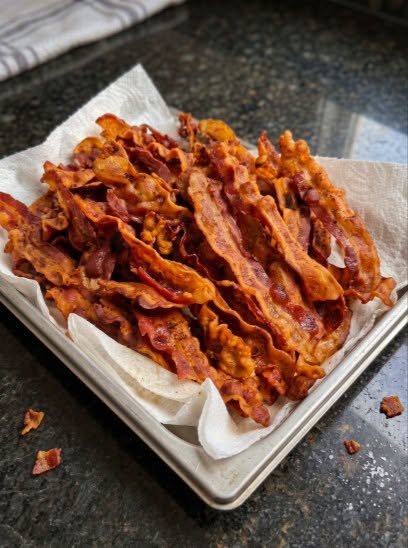
Main Ingredient
- 8 slices thick-cut or regular-cut bacon
- Optional: freshly ground black pepper
- Optional: maple syrup or brown sugar for a sweet variation
That’s it!
For classic crispy bacon, you really don’t need to add oil or butter. Bacon already contains plenty of fat to cook itself.
Tools You’ll Need
You don’t need a fancy setup.
- Large skillet or frying pan
- Tongs
- Paper towels
- Large plate
- Optional wire rack
- Optional fine-mesh strainer for saving bacon grease
A heavy-bottomed skillet, such as cast iron or stainless steel, works especially well.
Thick-Cut vs. Regular Bacon
Both work beautifully, but they cook a little differently.
Regular-cut bacon: Cooks relatively quickly and becomes very crisp.
Thick-cut bacon: Takes longer and tends to have a meatier texture with a crisp exterior.
If you want bacon that shatters when you bite into it, regular-cut bacon is often the easiest choice.
If you prefer substantial, hearty slices with crispy edges and a little chew in the center, thick-cut bacon is fantastic.
How to Make Crispy Fried Bacon
Here’s where the magic happens!
Step 1: Start With a Cold Skillet
Place the bacon slices in a cold, dry skillet.
Don’t preheat the pan first.
Arrange the slices in a single layer. It’s okay if they’re touching slightly because bacon will shrink as it cooks.
Starting cold gives the bacon fat time to slowly render before the meat becomes too hot.
Step 2: Turn the Heat to Medium-Low
Place the skillet over medium-low heat.
Let the bacon cook slowly.
You should hear a gentle sizzle rather than an aggressive popping and splattering.
This slower cooking process helps render the fat evenly and gives the bacon time to develop that beautiful golden-brown color.
Step 3: Let the Bacon Cook
Cook the bacon for several minutes on the first side.
As it cooks, you’ll notice the fat beginning to melt into the skillet.
Once the underside is browned and the bacon begins to curl slightly, use tongs to flip it.
Depending on the thickness of your bacon, this can take roughly 4 to 7 minutes.
Step 4: Flip and Continue Cooking
Turn each slice over and continue cooking.
Keep an eye on the pan because bacon can go from perfectly browned to burned surprisingly quickly once it gets close to being done.
Continue cooking until the second side is browned and the bacon reaches your preferred level of crispiness.
For most bacon, the total cooking time will be around 8 to 15 minutes, depending on thickness, skillet, and heat.
Step 5: Transfer to Paper Towels
Use tongs to move the cooked bacon onto a plate lined with paper towels.
Let it sit for a minute or two.
The paper towels absorb some of the excess grease, while the bacon continues to firm up as it cools.
And here’s an important little trick:
Don’t judge the final crispiness while the bacon is still sizzling in the skillet.
It becomes noticeably crispier as it cools.
Step 6: Serve Immediately
Now comes the best part.
Serve the bacon while it’s warm and crisp.
Or crumble it over your favorite dish and try not to eat half of it before it reaches the table.
I know. Easier said than done!
How to Get Extra Crispy Bacon
If you’re after seriously crunchy bacon, these little details can make a big difference.
Don’t overcrowd the pan
Too many slices packed tightly together can trap moisture and prevent proper browning.
Use a larger skillet or cook the bacon in batches if necessary.
Don’t crank up the heat
High heat may seem like the fastest way to crisp bacon, but it can cause the outside to burn before the fat has properly rendered.
Medium-low to medium heat gives you much more control.
Flip occasionally
You don’t need to constantly move the bacon around, but flipping it once or twice helps both sides brown evenly.
Let it drain
Removing the bacon from the grease when it’s finished allows it to crisp as it cools.
Should You Add Oil to the Pan?
No.
For traditional fried bacon, additional cooking oil isn’t necessary.
Bacon naturally releases plenty of fat as it cooks.
Adding oil can actually make the finished bacon unnecessarily greasy.
What If Your Bacon Is Cooking Too Fast?
If the bacon is browning rapidly or the grease is smoking heavily, lower the heat.
If necessary, briefly remove the skillet from the burner.
Remember, there’s no prize for cooking bacon as quickly as possible!
The goal is even browning and proper fat rendering, not speed.
How to Prevent Bacon From Curling
Some bacon naturally curls as it cooks.
If you prefer flatter slices, there are a few things you can try.
- Use a heavier skillet.
- Flip the bacon occasionally.
- Avoid excessively high heat.
- Gently press the bacon down with tongs during cooking.
You can also use a bacon press if you regularly make large batches.
But honestly? A little curl isn’t a bad thing.
Those crispy, ruffled edges are one of my favorite parts!
Flavor Variations
Classic bacon is hard to beat, but you can have a little fun with it.
Maple Bacon
Brush cooked bacon lightly with maple syrup during the final minute of cooking.
Watch it closely because the sugar can burn quickly.
Brown Sugar Bacon
Sprinkle a small amount of brown sugar over the bacon before cooking for a sweet-and-savory variation.
Pepper Bacon
Add freshly cracked black pepper for a little extra bite.
Spicy Bacon
Sprinkle the bacon lightly with cayenne pepper or crushed red pepper flakes before cooking.
Garlic-Herb Bacon
For a savory twist, add a tiny amount of garlic powder and dried herbs after cooking.
Ways to Serve Crispy Bacon
Of course, you can eat it straight from the plate.
But if you want to turn that crispy bacon into part of a meal, there are endless possibilities.
Breakfast
Serve it with:
- Scrambled eggs
- Fried eggs
- Omelets
- Pancakes
- Waffles
- French toast
- Toast
- Breakfast potatoes
- Biscuits
Sandwiches
Crispy bacon is perfect in:
- BLTs
- Grilled cheese
- Turkey sandwiches
- Chicken sandwiches
- Club sandwiches
- Burgers
- Breakfast sandwiches
Salads
Crumble bacon over:
- Caesar salad
- Cobb salad
- Potato salad
- Garden salad
- Wedge salad
- Pasta salad
Dinner
Add it to:
- Baked potatoes
- Mac and cheese
- Green beans
- Brussels sprouts
- Pasta
- Mashed potatoes
- Casseroles
- Soups
And don’t forget bacon bits over a creamy baked potato.
That combination never gets old!
Can You Save Bacon Grease?
Absolutely.
Once the grease has cooled slightly, strain it through a fine-mesh strainer into a clean, heat-safe container.
Refrigerate it and use it later for cooking.
A small spoonful can add incredible flavor to potatoes, vegetables, beans, eggs, or cornbread.
However, don’t pour hot bacon grease down the sink. It can cool, solidify, and contribute to clogged plumbing.
Storage Instructions
Cooked bacon is best when eaten fresh, but you can store leftovers.
Refrigerator
Place cooled bacon in an airtight container and refrigerate for up to 4–5 days.
Freezer
For longer storage, cooked bacon can be frozen.
Place cooled strips in a freezer-safe container or bag, separating layers if necessary.
For best quality, use within about 1 month.
You can reheat individual slices in a skillet, microwave, or air fryer.
How to Reheat Crispy Bacon
Skillet
Place bacon in a skillet over medium-low heat for a couple of minutes per side.
Oven
Place bacon on a baking sheet and warm at about 350°F until heated through.
Air Fryer
Air fry at approximately 350°F for a few minutes, checking frequently.
Microwave
Place bacon between paper towels and microwave in short intervals until warm.
The microwave is convenient, but be careful not to overcook it because bacon can become tough very quickly.
Tips for Perfect Fried Bacon Every Time
Here are the little things that make the biggest difference.
- Start with a cold skillet.
- Don’t add oil.
- Cook over medium-low to medium heat.
- Don’t overcrowd the pan.
- Flip the bacon at least once.
- Watch closely near the end.
- Drain on paper towels.
- Remember that bacon crisps more as it cools.
- Save the rendered fat for another recipe if desired.
And one more tip:
Cook more than you think you’ll need.
Because somehow, eight slices of bacon have a mysterious way of becoming five slices before breakfast even hits the table!
Recipe at a Glance
| Category | Details |
|---|---|
| Prep time | 2 minutes |
| Cook time | 8–15 minutes |
| Total time | About 10–17 minutes |
| Servings | 4 |
| Method | Skillet |
| Cuisine | American |
| Main ingredient | Bacon |
| Difficulty | Easy |
Frequently Asked Questions
Should I put bacon in a hot or cold pan?
For this method, start with a cold pan. It allows the bacon fat to render gradually and can help the bacon brown more evenly.
What temperature should I fry bacon?
Medium-low to medium heat works well. The exact setting depends on your skillet and stovetop.
Why isn’t my bacon getting crispy?
La poêle est peut-être trop remplie, le feu trop faible, ou le bacon a tout simplement besoin de cuire plus longtemps. N’oubliez pas non plus que le bacon devient plus croustillant en refroidissant.
Pourquoi mon bacon brûle-t-il avant d’être croustillant ?
Le feu est probablement trop fort. Le bacon contient du sucre et des protéines qui brunissent rapidement, tandis que la graisse a besoin de temps pour fondre. Baissez le feu et poursuivez la cuisson plus doucement.
Ai-je besoin de beurre ou d’huile ?
Non. Le bacon libère sa propre graisse à la cuisson.
Comment savoir quand le bacon est cuit ?
Recherchez une couleur brun doré foncé et la texture que vous préférez. N’oubliez pas qu’elle se raffermira en refroidissant.
Peut-on faire cuire du bacon congelé ?
C’est possible, mais le bacon décongelé est plus facile à séparer et à cuire uniformément. Pour une cuisson optimale à la poêle, décongelez-le d’abord au réfrigérateur.
Peut-on cuire du bacon sans le retourner ?
Oui, mais les retourner permet généralement de les faire dorer plus uniformément.
Puis-je préparer le bacon à l’avance ?
Oui. Le bacon cuit peut être conservé au réfrigérateur et réchauffé au besoin. Il risque de perdre un peu de son croustillant d’origine, mais le réchauffer à la poêle ou à la friteuse à air chaud peut lui en redonner une partie.
Réflexions finales
Il y a quelque chose de délicieusement désuet dans une poêle pleine de bacon qui grésille sur le feu.
Pas d’ingrédients compliqués.
Pas de technique sophistiquée.
Du bon bacon, un peu de patience et une cuisson parfaite.
Le secret est simple : ne précipitez rien. Utiliser une poêle froide et laisser la graisse du bacon fondre lentement vous permettra de mieux contrôler la texture finale.
Et une fois que vous retirez ces belles lamelles dorées de la poêle et que vous entendez ce petit craquement à la première bouchée ?
Ouais.
Voilà un petit-déjeuner réussi.
Si vous essayez cette méthode, j’adorerais savoir comment votre bacon a pris ! N’hésitez pas à laisser un commentaire et à partager une photo de votre bacon croustillant sur Pinterest pour que d’autres cuisiniers amateurs puissent admirer votre résultat.
D’autres recettes que vous pourriez adorer
Si vous aimez le bacon, ne vous arrêtez pas là ! Essayez d’utiliser votre bacon croustillant dans :
- Salade de petits pois au bacon
- Soupe de pommes de terre au four
- Cheeseburgers au bacon
- Purée de pommes de terre garnie
- Casserole d’œufs pour le petit-déjeuner
- Sandwichs BLT classiques
- Gratin de pommes de terre au bacon et au fromage
- Poulet enrobé de bacon
Une fois que vous avez une fournée de bacon croustillant prêt à l’emploi, les possibilités sont pratiquement infinies.
Informations nutritionnelles
Les valeurs nutritionnelles approximatives varient en fonction de la marque, de l’épaisseur et de la quantité de bacon utilisée.
Pour 2 tranches de bacon cuit , une estimation typique est :
- Calories : environ 80 à 100
- Protéines : environ 6 à 7 g
- Matières grasses : environ 6 à 8 g
- Matières grasses saturées : environ 2 à 3 g
- Glucides : 0–1 g
- Sodium : environ 300 à 500 mg
Ces chiffres sont des estimations et sont fournis à titre d’information générale.
LA SUITE DANS LA PAGE SUIVANTE
